Close the gap between strategy and execution
ISO BPMS connects every department — sales, operations, finance, HR — under one platform. Real-time operational visibility for leadership. AI-powered execution for every team.
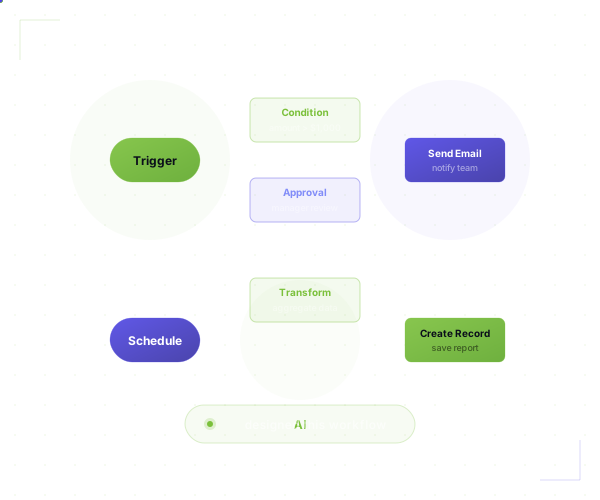
Full operational control — from strategy to execution
Give leadership the visibility they need and give every team the tools to deliver. Without the complexity of enterprise software or the cost of a consulting engagement.
A single source of operational truth
Customer pipeline, project status, headcount data, vendor contracts, invoices — all in one system of record. No more reconciling data from five different tools before a board meeting.
Processes that run themselves
Define how work flows, who approves it, and what happens when deadlines are missed. The platform enforces your governance standards automatically, consistently, across every team — without reminders or follow-ups.
Scale operations without adding overhead
Automate the coordination, status updates, and manual handoffs that grow linearly with headcount. Handle more business with the same team — or redeploy people to higher-value work.
Nine operational modules. Live in 30 days.
CRM, HR, Finance, Procurement, Projects, and more — each pre-built with the workflows, approvals, and data structures your department needs. Operational from day one, with no implementation project.
Cross-functional visibility in one dashboard
Every department, every process, every status — visible to leadership in real time. No more assembling monthly reports. No more asking teams for updates. The information is always current.
Integrate with your existing enterprise systems
Connect ISO BPMS to your ERP, CRM, or finance system via API. Data flows automatically — no middleware, no integration project, no ongoing maintenance burden.
Trusted by leadership teams across Asia and beyond
"We replaced four separate operational systems with ISO BPMS. Our executive team now has real-time visibility across every department — data our BI team used to compile manually every month."
"When our business model changed, we reconfigured our core processes in a week. That kind of operational agility was simply not possible with our previous systems."
"For the first time I can walk into a board meeting with live operational data instead of last month's spreadsheet. The executive visibility alone justified the investment."
Executive questions, answered
How quickly can our organization see results?
Most organizations are operational within their first department in 30 days or less. There is no custom development phase, no lengthy IT project, and no consulting engagement required. Executive dashboards are available from day one.
What is the total cost compared to our current tools?
Organizations typically consolidate 3 to 5 separate operational tools onto ISO BPMS. Beyond license savings, teams report significant reductions in manual coordination, status reporting, and process exceptions — costs that rarely appear on a software budget but accumulate quickly.
How does ISO BPMS integrate with our existing ERP and finance systems?
ISO BPMS connects to existing enterprise systems via a standard REST API. Your IT team can establish integrations in days. We also support data imports for migration from legacy systems.
How do you handle data security and compliance requirements?
Each organization operates in a fully isolated environment. Your data is never co-mingled with other customers. We support SSO for enterprise identity management, role-based access controls, and complete audit logging for every action.
Can we implement one department at a time?
Yes — and most organizations choose this approach. Start with the highest-pain operational area, prove the value, and expand. The platform is designed to grow with your organization without re-implementation or data migration.
Latest from the Blog
Beyond CRM: Why Sales Leaders Need Connected Revenue Operations
Your CRM tracks contacts. But closing deals at scale requires process alignment across every team that touches the customer.
Read more →Procurement in the Modern Enterprise: From Purchase Orders to Strategic Value
Leading procurement organizations are transforming from cost centers to competitive advantage. Here is the operating model that makes it possible.
Read more →How IT Leaders Can Enforce Process Compliance Without Becoming the Bottleneck
IT is responsible for governance but blamed for slowing teams down. A unified process platform changes that dynamic.
Read more →From Reactive to Proactive: How Operations Leaders Build a Command Center, Not a Dashboard
Most operational dashboards tell you what already happened. The best ones tell you what is about to go wrong — and who should act.
Read more →Why Finance Teams Lose Days Every Month to Manual Reconciliation — and How to Fix It
The hidden cost is not just time. Manual reconciliation creates audit risk, delayed decisions, and CFO blind spots.
Read more →How HR Leaders Can Eliminate Manual Processes and Focus on What Matters
HR teams spend up to 40% of their time on administrative tasks. Here is how unified process management changes that equation.
Read more →